3. Medical Staff Users
- In-patients
- Discharge prescriptions (inc. short term leave)
- Cytotoxic regimens
- Total parenteral nutrition
- Out-patients
- In-patients
The basic starting process is broadly the same i.e.
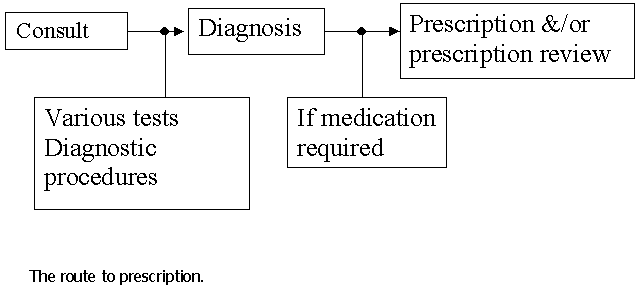
Whilst this is a grossly simplistic view of the process nevertheless it remains a valid starting point. The impact of the prescribing system will be in supporting the process of prescribing the basic method of which has changed very little over the years. Such a system must not only facilitate the process above and beyond the current method(s); it MUST also provide information rich decision support for the prescriber.
If we now look at a part of the above process in more detail, the process of drug selection (the requirement for therapy/chage of therapy having been made). It could be charted as:
 This is again simplistic but valid. This can be taken forward to the system
requirements that follow. Indeed you could argue that the starting point would be the WeBNF
or version of a formulary whether national, local or personal either adult or paediatric
and so on.
This is again simplistic but valid. This can be taken forward to the system
requirements that follow. Indeed you could argue that the starting point would be the WeBNF
or version of a formulary whether national, local or personal either adult or paediatric
and so on.
The first and foremost point is accesibility, any system must be accessible, I for one cannot envisage busy Doctors waiting thier turn to write(electronically) a script, or consultant teams having to schedule ward rounds around the availability of the hardware! It must be fast access, once into the system. Ask yourself the following question when considering this, how long does it take to write a script for amoxycillin 250mg TDS? Then consider that for electronic prescribing to be accepted it has to deliver not only speed but add value to a system that has been fined tuned over a number of years, as a colleague said to me "the best you can hope for, at this stage, is that prescribers remain fairly non-plussed about the system." Since we are such an early stage of development of what is a fairly large culture change then this is fair comment. In time, though this is not what we should accept, the software available now is capable and the technology available. We should aim then to exploit this to our advantage/requirements and not those of the few suppliers. After all we are the ones with the years of hands on experience. I cannot stress this last point too highly, intransigent, expensive suppliers with a history of poor delivery are not going to be an option in this area of health informatics, its just to important to get bogged down in mediocrity and failure to realise the potential benefits of this development.
To return to the interface the following summarises the user interface
as I see it at present:
(best viewed full screen)
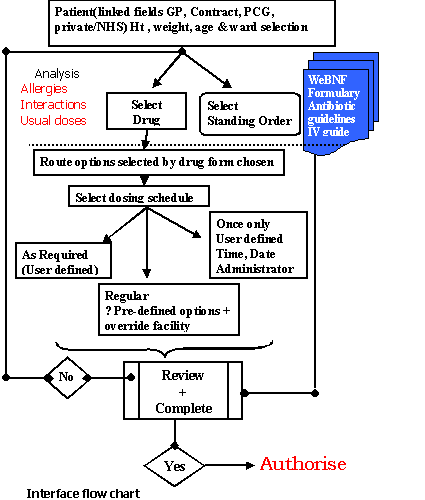
Another colleague suggested to me that surely the ideal interface would be the electronic version of what is used at present? Namely the WeBNF, linked as it can be to IV guides and formularies...Perhaps a most valid point which suppliers might like to consider. Combined with user defined personal formularies this could be a most interesting possibility.
The system requirements will start with the generalities before progressing onto the specifics concerned with types of prescription, from in-patients to cytotoxic prescriptions.
General System Requirements
- The system must be user friendly
- The system must be secure
- The system must be fully auditable
- It must be as easy and as fast to prescribe medicines on the electronic system as it is on a paper based system
- Any potential supplier must demonstrate full and on-going commitment to developing the system in line with end user requests
- The system must have definable access facilities E.g. HO, SHO, REG, SR & Consultant
- The system must allow entry of height, weight and age (if not available from PMS and have upload to PMS if this is the case)
- The system must be able to calculate Ideal body weight (IBW) and body surface area (BSA) from above parameters. These may be used for subsequent calculations e.g. in Chemotherapy, TPN or TDM
- The system must have pro-active analysis of recorded allergies, clinically significant interactions (As listed in BNF appendix 1)
- The system must allow entry of future start and finish dates for prescribed medicines
- The system must allow amendments to prescriptions by a clinician that may be different than the original prescriber. Having done so responsibility would be switched from the original to the new prescriber and electronic signatures recorded.
- The system must be able to handle prescribing for adults and paediatric patients
- When prescribing for paediatric patients the system must display the dose as a mg/kg/day or mg/kg (either total daily dose or each individual dose) figure as well as the mg dose.
- The system should have a facility to validate paediatric dosages.
- The System must have a formulary/non-formulary guide which is controlled by user defined parameters E.g. Consultant authorisation, approved non-formulary usage/prescribers facilities to record reasons for using limited prescribing drugs
- The system must have facilities for handling & storing standing orders e.g. for triple therapy as well as group protocols
- The system must be able to cope with prescribing of IV fluids, Continuous IV infusions (Via Pumps? Which would be specifiable from a user defined list) IV infusions of drugs and administration via the IV/IM/SC/IA/IT/PCA routes. This would include those able to prescribe and administer plus diluents to be used.
- The system must allow prescribing of drugs not on file for the system (e.g. new drugs out of hours)
- Such drug prescriptions must be easily reported on.
- The system must allow use of clinical trial drugs/protocols
- It must be possible to report on clinical trial drugs used.
- At the point of entry a prescriber must be able to review PMH
- At any point in the process a prescriber must have access to detailed monographs of drugs either selected for prescription or user defined (see WeBNF requirement. BNF entry would be a minimum standard)
- The system must have easy to use, fully customisable reporting facilities for example, for audit purposes or medication review
- The system must allow & record administration of medicines outside of a drug administration round (e.g. IV drugs limited to Drs. only, stat. Doses, Drugs used in MI emergency situation)
- There must be a switchable (Ward & individual?) flag for patient self-administration wards to comply with the Trusts self-administration procedures.
- The system must have facilities to print a medicine chart (e.g. when patient transferred to another unit, goes for dialysis e.t.c.)
- There should be a facility to check microbiology recommendations (if applicable) when prescribing antibiotics.
- The system should have a facilities for individual prescribers formularies (I.e. those drugs that are used most often by that prescriber)
- The system should be linked to the WeBNF developed by the CBCU at Addenbrookes
- The system should be linked to the Trusts IV guide
- The system should have facility to give the option of usual dosage for drug selected
- There should be access to the system via hand held/palm top PCs
The follwing pages will look at the sub-catagories as outlined above. It is important to bear in mind what has been outlined above when looking at these sections.
equally important is that prescribing Per Se and who does what is under review. The Crown report which looks at the supply and administration of medicines under group protocols is worth reading. Group protocols are ideally suited to electronic prescribing being templates with associated rules. In this section and the following it is thus important to bear in mind that it may not be just members of the medical profession this could apply to.